Getting Down to a New Life
Notes from Qudsiya


Hello my dear DTTS community! I hope you are easing into 2026 with gentleness in the midst of all that is going on in our world. I took a much-needed break from the news cycle over these last several weeks, and though it was healing, I was stunned to return to deadly ICE violence, a U.S. military attack on Venezuela, and new threats against disabled immigrants through the Trump administration’s proposed public charge rule. It’s a lot to take in, but I’m so grateful thatI do not have to do it alone.
As the team slowly emerges from our hiatus, we can’t wait to bring you more conversations about disability, design, and intersectionality. We hope that the stories we share serve as both a healing balm in these challenging times and a reminder of how much we can learn about building a just and peaceful society from disability culture and the principles of disability justice. To that end, Ilana and I are thrilled that we have a new team member. Together, we’re excited to shepherd Down to the Struts into 2026 and beyond.
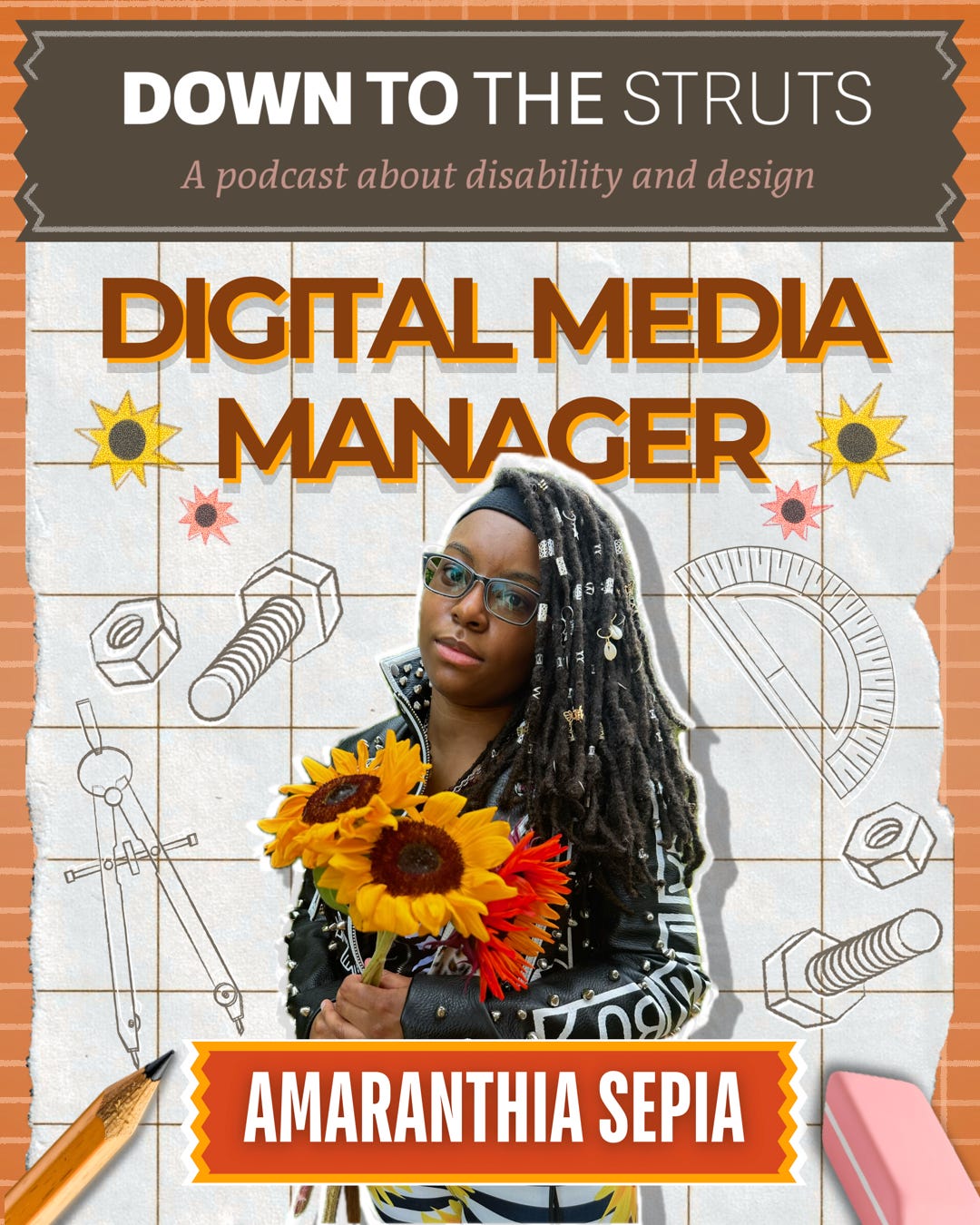
I’m very pleased to introduce Amaranthia Sepia. Amaranthia is an invisibly disabled virtual art director, creative, and Black mental health/disability advocate. She is a 2024 NH Panther Black Excellence awardee, and along with her mother, Claire Jones, she is the co-founder of Sista Creatives Rising, an art advocacy project designed “to help creative marginalized women and marginalized genders gain accessibility and visibility in the arts to facilitate personal healing.” (Instagram)
Amaranthia will be leading our digital media strategy, including updates to our website, our YouTube presence, and helping me to curate this very newsletter. You can learn more about her artworks and graphics via Amaranthia Sepia Artworks (Instagram). Thank you, and welcome, Amaranthia!
Getting Down to a New Life
On November 16, 2025, my husband, Sean Collins, and I welcomed our daughter, Ruhi Aleema Naqui Collins. We wanted to give her a name as a hopeful foreshadowing of the person she will become. Her first name, Ruhi, means “soulful,” and her middle name, Aleema, means “wise.” As Kahlil Gibran has wisely said, “You are the bows from which your children as living arrows are sent forth.” We do not know where Ruhi’s arrow may fly, but we hope that our humble intentions create a strong bow from which she can set forth through life, balancing soulful spirit and grounding wisdom.
It felt deeply meaningful that Ruhi came into my life only two days after a mentor and guiding light, Alice Wong, passed out of it and became a disabled ancestor. As we shared in a recent tribute, Down to the Struts would not exist without Alice. I came across Alice’s Disability Visibility Project when I was launching the podcast back in 2020. Knowing no other disabled podcasters, I reached out to Alice, even though I had no connection to her. To my great surprise, she responded within 24 hours and connected me with another disabled podcaster and access artist, Cheryl Green, who then introduced me to blind podcaster and audio description expert, Thomas Reid.
Alice, Cheryl, and Thomas gave me invaluable advice and guidance—from which microphone to purchase, to the importance of having transcripts of every episode to expand access for the Deaf and hard of hearing community and those with auditory processing conditions. From my connection with the three of them, I wove a web of incredible disabled mentors and colleagues who exposed me to disability culture, the principles of disability justice, and the power of disability community.
I do not know yet what Ruhi’s relationship to disability will be, but as Jennifer Natalya Fink explained when I interviewed her about her book All Our Families, “A family is a story, it’s a myth—as much as it’s the fact of lineage, it is the story a family is telling about itself.” Alice, Cheryl, Thomas, and others in my disability community are not my biological family of origin, but they are a part of my disability lineage, along with the disabled people (sung and unsung) in my actual family. If my story is the bow from which Ruhi’s new life must launch, that bow has the strength to let her fly because of all of these people and their insistence that all bodies and minds deserve justice, inclusion, and access. I am eternally grateful that Alice, during her life, became a part of my story that I can now share with my daughter.
In 2026, I wish you all the joy of new life—of all the new arrows that will spring from the bows of our stories and the stories of our ancestors.
Shout-Outs & Goings-On
On Thursday, January 29 at 4pm PT/7pm ET, I’ll be joining team Unseen to host a second know your rights webinar for disabled immigrants, their families, and allies. Your Rights to Access – Revised, Expanded and Ready builds upon our popular Summer 2025 webinar. We’ll offer expanded know-your-rights info related to encounters with immigration enforcement authorities at home, work, and healthcare settings. We will feature scenarios to review, as well as disability-specific information. This presentation is not intended to provide legal advice. We will not be providing specific guidance on individual cases.
Back in November, I was honored to join Lynn Borton on her fabulous podcast, Choose to Be Curious. Lynn and I talked about disability within the broader lens of curiosity. This is a beautiful show in general, and definitely worth a listen.
Mustafa Rfat has published a new and important article that includes critical guidance for medical professionals on how they can support disabled refugees in applying for citizenship. According to Mustafa’s research, there are an estimated 47,000 disabled refugees who lost their SSI because they were unable to obtain their citizenship within seven years.
Huge belated congratulations to Day Al-Mohamed for receiving the 2025 Anthem Award for her documentary series, Renegades, “showcasing the lives of lesser-known historical figures with disabilities, exploring not only their contribution to U.S. society, but also the concept of disability culture.”
Warmest congratulations to Set Hernandez, who was recently selected for the 2026 USA Fellowship, which is awarded to 50 artists “based on their artistic visions, unique perspectives within their fields, and potential for the award to make a significant impact on their practice and lives.”
The incomparable Lachi received a Grammy nomination, along with collaborator Christopher Redding, in the Best New Age Album category for their album, The Colors in My Mind, which celebrates neurodivergence.
Thanks for reading our newsletter. We’ll be back soon with more news from the podcast and the disability community!
In solidarity,
Qudsiya
 | A guest post by
|